


Fabric Cutting for Stretch Knits: Grain Alignment and Relaxation Explained
Fabric Cutting for stretch knits requires more than accurate pattern placement. A panel can match its template on the cutting table and still shorten, widen, or twist after handling and washing. Residual tension, misaligned wales, and uneven spreading can all contribute to distorted components and inconsistent fit.
For technical evaluators, the critical question is not simply whether a supplier can cut accurately. It is whether the fabric is stable enough to cut, whether the pattern follows the intended structural direction, and whether those conditions remain consistent throughout the lay. Understanding these relationships makes it easier to distinguish a cutting problem from a material or finishing problem.
Why stretch knits move after cutting
Knitted fabrics are built from intermeshing loops rather than intersecting warp and weft yarns. Those loops can change shape under relatively small forces. Elastane increases extensibility and recovery, but even knits without elastane can stretch considerably because of their construction.
During knitting, dyeing, finishing, winding, and transport, fabric may acquire temporary deformation. A tightly wound roll, for example, can hold fabric in an extended state. Once unwound and left without restraint, its dimensions may change as the structure redistributes stress.
Cutting releases additional constraints. A component that looked correct while attached to the surrounding fabric may retract once separated. This is particularly troublesome with narrow bands, close-fitting panels, and components whose dimensions must match a less extensible material.
Three related properties should therefore be assessed separately:
- Relaxation: dimensional movement after fabric is released from winding or handling tension.
- Stretch and recovery: extension under a specified force and the degree of recovery after unloading.
- Dimensional stability after care: size and shape changes following the intended washing, drying, or other care procedure.
A fabric can become stable on the cutting table yet still shrink or develop spirality after laundering. Relaxation is necessary process control, not proof of finished-product stability.
Finding the grain: follow the loops, not just the edge
In knitted fabric, wales are the columns of loops, generally running lengthwise; courses are the rows, generally running across the width. Pattern grainlines commonly reference the wale direction, unless the design or material specification requires another orientation.
The visible fabric edge is not always a dependable grain reference. Open-width edges may curl, finishing may introduce distortion, and tubular fabric can be slit off the intended line. Treating an edge as automatically parallel to the wales can carry that error into every cut component.
A practical alignment check
Place an unstrained sample on a flat surface and inspect the loop structure under suitable lighting. A magnifier can help with fine-gauge or dark fabrics. Trace a wale at several positions across the width, then compare it with the proposed pattern grainline. Inspect courses separately to identify bow and skew.
Bow occurs when a course curves across the width. Skew occurs when courses run at an angle rather than perpendicular to the intended lengthwise reference. Both can affect panel appearance and matching, although their effects depend on construction and garment geometry.
Do not stretch the fabric diagonally until it appears square and then cut it under that restraint. The apparent correction may disappear when the pieces are released. Persistent distortion needs material review, finishing correction where feasible, or a documented acceptance decision.
Also distinguish wale alignment from maximum stretch direction. Many weft knits stretch more across their width, but this is not universal. Construction, elastane placement, and finishing can change the relationship. Pattern orientation must satisfy both the structural grain requirement and the functional stretch requirement.
Relaxation should have an endpoint, not only a waiting time
A fixed instruction such as “relax overnight” is easy to communicate but weak as a standalone control. Required relaxation depends on fabric construction, roll tension, elastane content, finishing history, storage conditions, and the sensitivity of the intended product.
A more defensible procedure combines a validated minimum holding period with dimensional checks. The purpose is to demonstrate that further change is small enough for the product’s tolerance, rather than assuming that elapsed time guarantees stability.
Establish conditions that do not introduce new tension
Unwind fabric into loose folds or another supported arrangement that avoids hanging weight and compression. Do not leave it stretched between supports or packed tightly into a container. Keep the material identified by roll and lot, and protect it from contamination.
Record the conditions around the relaxation area. Temperature and relative humidity matter because moisture response and elastic behavior vary by fiber system. For comparative laboratory testing, use the conditioning atmosphere required by the applicable method; ISO 139 provides standard atmospheres for conditioning and testing textiles. Production-floor holding conditions should be documented separately rather than described as laboratory conditioning without verification.
Measure stability in both directions
On representative, unstrained specimens, establish reference distances in the lengthwise and widthwise directions. Measure them at defined intervals using the same support and measurement technique. The reference measurement must be clearly identified: a measurement taken after initial release will not capture movement that occurred before it.
A useful calculation is:
Dimensional change (%) = [(later dimension − reference dimension) ÷ reference dimension] × 100
A negative value indicates contraction under this convention. Keep the sign convention consistent in inspection records. If a marked distance changes from 500 mm to 495 mm, the recorded change is −1.0%; this illustrates the calculation, not a universal acceptance limit.
Set the allowable change between successive checks according to component tolerances and measurement capability. A small shift may be acceptable for a loose panel but significant for a fitted sports-cap insert or a narrow stretch band. Sampling should cover meaningful variation between rolls, not just the most convenient accessible piece.
Fabric Cutting accuracy depends on how the lay is built
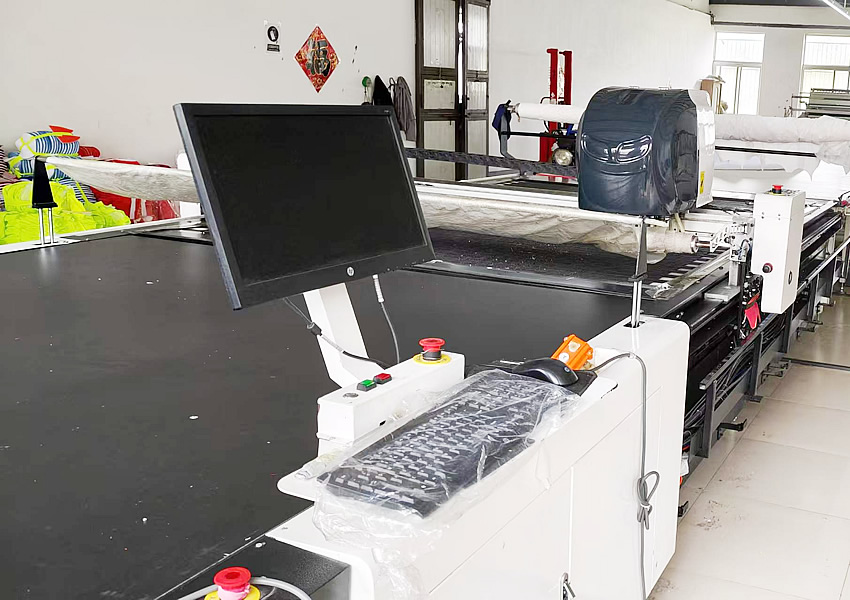
Relaxed fabric can be stretched again during spreading. Excessive feed tension, dragging, unsupported fabric weight, or repeated hand smoothing can undo the benefit of controlled holding.
The objective is to place each ply in its natural state, without wrinkles and without pulling it to match an expected width. Record usable width after relaxation; do not force a narrower roll to fit a marker designed for a wider one.
Edge curl deserves particular attention with single jersey. Pulling the edge flat can distort the adjacent cutting area. Depending on the material and equipment, an approved edge-control method, adjusted marker placement, or single-ply cutting may be preferable.
For tubular knits, verify whether the tube’s folded edges are suitable references. Folding does not establish grain automatically, and treating both sides as equivalent can conceal skew or unequal panel orientation.
Verify released components, not only the marker
An accurate digital marker proves little about the dimensions of a relaxed cut panel. First-off verification should include components after removal from the cutting bed and after an agreed recovery interval.
Measure critical dimensions without stretching the piece. Check grainline orientation, notches, symmetry where required, and matching edges. For multilayer cutting, inspect samples from the top, middle, and bottom of the lay. This helps separate a marker error from ply movement or blade-related deviation.
Small components can be especially revealing. In cut-and-sewn headwear, a band may retract while its mating panel remains comparatively stable, creating puckering or an uneven opening. Directly knitted hats and scarves follow a different manufacturing route, so cutting controls should not be presented as applicable to every knitted accessory.
A short pilot assembly provides another useful checkpoint. Evaluate the assembled shape before and after the specified care treatment. Twisting that emerges only after laundering may reflect yarn torque, knit structure, or finishing history rather than poor cutting alone.
Which standards support the evaluation?
No single test standard establishes a complete cutting approval procedure for stretch knits. A technical specification normally combines material tests, dimensional tolerances, process controls, and finished-product assessment.
For laundering-related dimensional change, ISO 3759 addresses specimen preparation, marking, and measurement; ISO 6330 specifies domestic washing and drying procedures for textile testing; and ISO 5077 addresses determination of dimensional change in washing and drying. The selected procedure must reflect the intended care conditions.
For stretch behavior, the ISO 20932 series provides methods for determining fabric elasticity. Select the applicable part, loading conditions, and reporting parameters for the material and end use. Results obtained under different loads or recovery periods should not be treated as directly interchangeable.
For spirality after laundering, the ISO 16322 series offers methods covering relevant fabric and garment forms. Confirm the appropriate part and current edition with the testing laboratory. These references support evaluation; they do not establish universal pass/fail limits for every stretch-knit product.
What a supplier’s records should demonstrate
When evaluating a manufacturing partner, request evidence that links the material to the actual production decision. Useful records include roll identification, relaxed usable width, dimensional observations, grain and distortion checks, spreading settings, first-off measurements, and any disposition of nonconforming material.
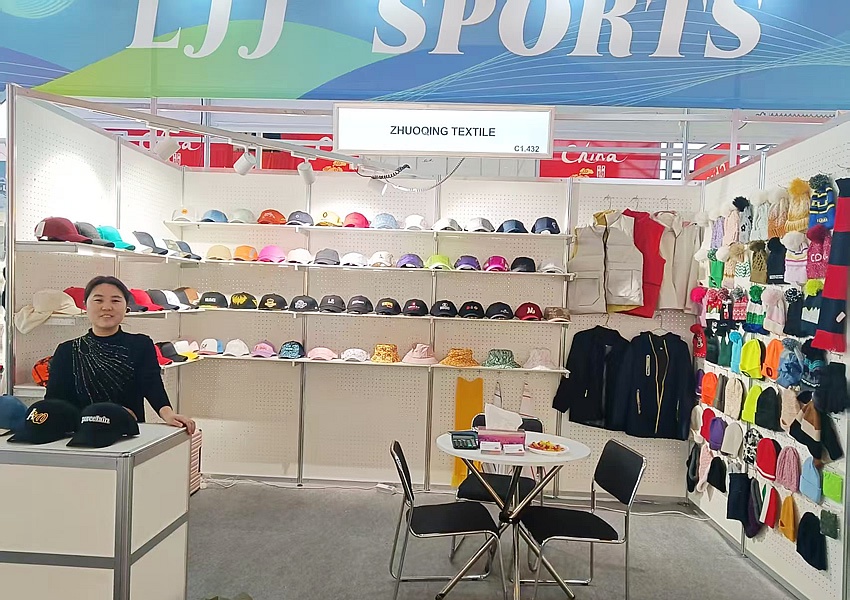
For buyers assessing Shijiazhuang Jinling Times Import and Export Trade Co., Ltd. for cut-and-sewn knit headwear or related accessories, its stated in-house cutting and sewing capabilities provide a relevant starting point. Technical approval should still depend on the proposed fabric, documented controls, and trial results—not equipment ownership alone.
The most informative question is often: “What evidence allows this roll and this lay to be released for cutting?” A credible answer connects measurable fabric stability with grain alignment, controlled spreading, and released-panel inspection.
Reliable Fabric Cutting starts before the blade moves. When relaxation is verified rather than assumed, and grain is checked against the knit structure rather than the roll edge, evaluators gain a clearer basis for judging repeatability—and fewer surprises when flat panels become finished products.
Hot News

Deeply rooted in textile foreign trade for 28 years, JINLING SHIDAI continues to strengthen the core competitiveness of its source factories
Recently, Shijiazhuang Jinling Times Import and Export Trade Co., Ltd. has continued to advance its upgrades in production standardization process refinement. Since the establishment of the factory in 1997
Read Article →Fully guarantee the delivery of foreign trade orders, and efficiently and steadily advance the peak season production capacity of Jinling Times.
Entering the peak season for foreign trade shipments this year, the production workshops of Jinling Times are operating at full capacity in an orderly manner, production schedules for various
Read Article →

{item.title}
{item.description}
Need Custom Caps?
Send us your artwork and quantity — a detailed quotation within 24 hours.